
You shipped fast. Now get your first customers.
Distribution is the hard part. Most vibe-coded apps die with fewer than 100 users because no one knew it existed.
Show me how to find customersYou built an app in days. Maybe hours. The tools made the hard part fast — and now the hard part is something else entirely. Getting customers is a different skill than building, and most indie builders hit a wall right here.
The apps that win aren’t always the most polished. They’re the ones that found the right people, said the right thing, and showed up in the right places before the momentum died. That window is shorter than most people think.
CorZen shows you how to position an AI-built app honestly, which channels work for indie launches, and what steady acquisition looks like once the launch spike fades.
By the numbers
Everything between the goal and the result
Your first 100 users are findable
They exist in communities, subreddits, Discord servers, and newsletters right now. The outcome of good positioning is that you know exactly where to find them & they recognize themselves in your message immediately.
Positioning without an apology
An AI-built app is a product. Ship it as one. When you name the problem clearly and show it works, fewer people care how it was built. The outcome is credibility without credentials.
A launch that generates signal
A good launch tells you who your real customer is, which message landed, and which channel is worth doubling down on. That signal is more valuable than any single sale.
Acquisition happens naturally
The right channels for an indie app compound over time — SEO, a small email list, a single community where you’re known. You stop trading time for every new user.
Word of mouth is powerful
When your app solves a specific problem for a specific person, they tell others who have the same problem. Narrow positioning is what makes organic referral possible.
A plan that survives week two
Most launch plans collapse after the first burst of activity. The outcome of a structured plan is that you know what to do on a Tuesday afternoon three weeks in — and you do it.
How it works, step by step

That’s how long it takes to go from business objective to a full weekly-task plan inside CorZen — ready to hand off to AI agents that do the marketing work.
What changes when you get this right
Customers describe your app to other people using the exact words you put on your landing page.
New signups arrive on weeks you didn’t post anything, because your content and SEO are doing the work.
You know which channel is worth more of your time — and you stop guessing.
Your launch spike becomes a floor, not a ceiling, because retention holds.
You’re building the next feature with paying users already in the product.
Distribution is no longer the thing keeping you up at night.
Frequently asked questions
Yes and no. Users care whether the app solves their problem. Lead with the outcome your product delivers, not how it was built. Transparency about using AI tools is fine — just don’t make it the headline. People want ‘AI-native’ solutions but do not want ‘vibe-coded AI slop’ and so CorZen guides you through how to use language to describe your tool without focusing on how it was built.
Go where the problem lives. Find communities where people complain about the exact problem your app solves. Be useful there first. Then show the product. Direct outreach to individuals still works at this stage — don’t skip it.
Go narrower. Bigger competitors serve everyone, which means they serve no one perfectly. Find the specific person with the specific problem your app solves best, and speak only to them. Narrow wins early. Excel was included automatically with most computer shipments yet AirTable built a sizable business by serving the market that didn’t want Excel. The size of your competitor is irrelevant if you have a strong customer acquisition plan.
You describe your goal. CorZen runs a discovery interview and generates a plan with weekly tasks. Each task can be handed to a specialized marketing agent — copywriting, SEO, email, paid ads — that produces the actual deliverable.
The spike is not the business. After it fades, you need one content channel, one community, and one retention hook. Those three things, done consistently, build acquisition that doesn’t require a new launch every month.
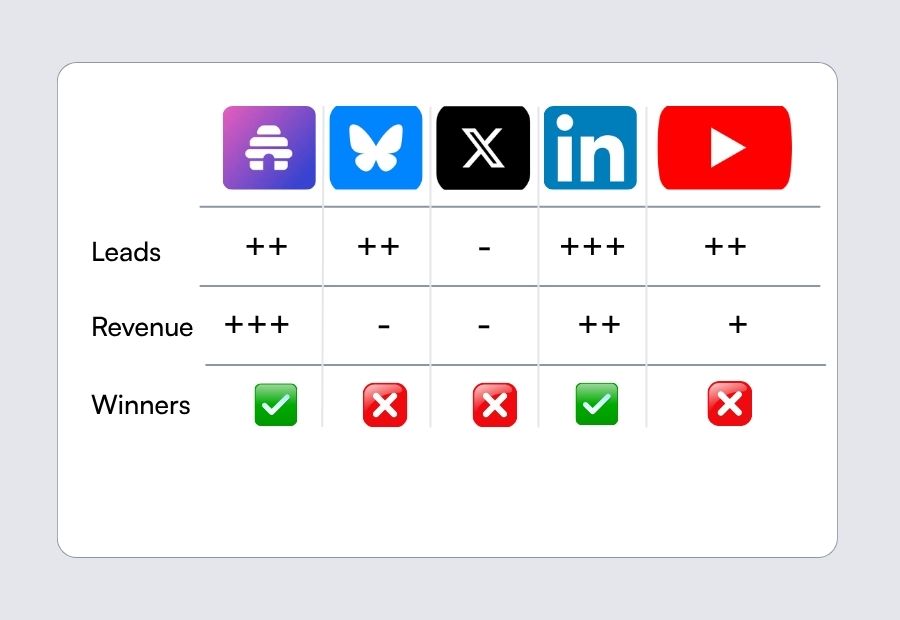
Product Hunt still drives awareness, but it’s a spike, not a strategy. Communities — niche subreddits, Discord servers, Slack groups — convert better for early traction. SEO compounds over months. Adding a weekly newsletter for your subscribers boosts retention and referrals. Pick two and commit.
Find customers.
Set your goal. Answer a few questions. CorZen turns it into a week-by-week plan you can run without guessing what comes next.
Choose the speed of customer acquisition