
Launch faster with a SaaS go-to-market strategy that holds.
Most SaaS launches fail because distribution is based on guessing and random advice from Reddit. A tight GTM strategy closes the gap between your product being ready and your pipeline being full.
Generate my SaaS GTM planSaaS GTM is not a marketing plan. It is a decision about who you sell to, how they find you, what they pay, and why they stay. Get those four things right and growth compounds. Get them wrong and you spend six months optimizing the wrong channel for the wrong customer.
Traditional GTM relies on long sales cycles, field reps, and enterprise contracts. SaaS compresses all of that. Your buyer can sign up, use the product, and churn before a traditional sales rep would have sent the first follow-up email. That speed is the opportunity. It is also the risk.
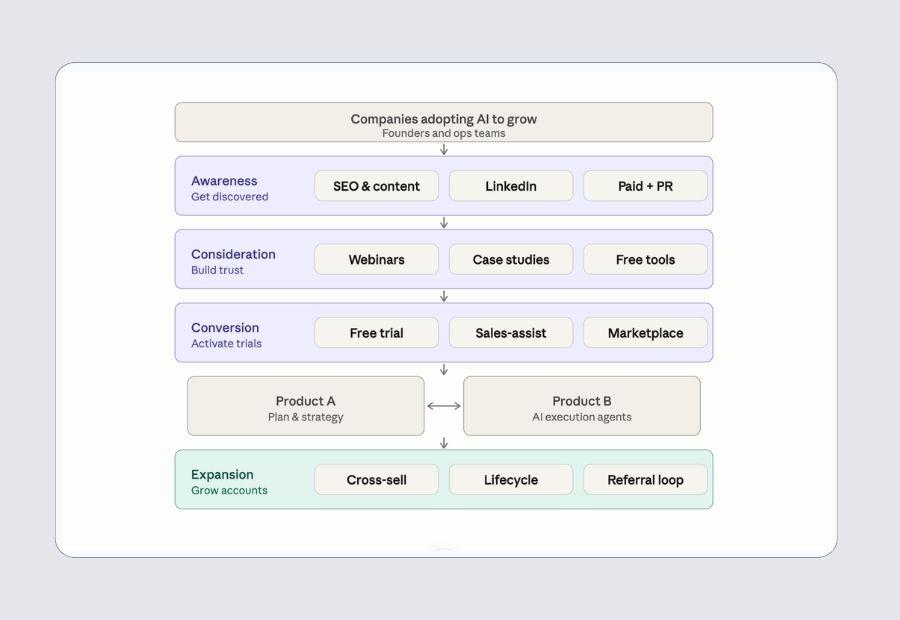
The companies that win on SaaS GTM are not the ones with the biggest budgets. They are the ones who pick a strategy — product-led or sales-led — and implement it without splitting their attention between both at once.
By the numbers
Everything between the goal and the result
ICP clarity that converts
When your ideal customer profile is specific, your messaging stops being generic. The right prospects recognize themselves immediately and qualification happens before the first call.
A channel mix with a thesis
PLG and sales-led growth are not interchangeable. Picking one and building around it means every dollar and every hour pulls in the same direction.
Pricing that does not sink you
Freemium works when your product sells itself. Usage-based works when value scales with use. Mismatching pricing to value is one of the most common reasons early SaaS stalls.
A launch week with momentum
Most SaaS launches lose momentum in week two because there is no plan for what happens after the announcement. A week-by-week checklist keeps the revenue coming.
Retention built into the GTM
The best GTM strategies treat activation and retention as part of acquisition. If your onboarding does not deliver the promised value, no channel spend fixes the churn.
A feedback loop from day one
Early customers tell you whether your positioning is working faster than any analytics tool. The GTM strategy that survives first contact is the one built to listen and adjust.
How it works, step by step
A SaaS GTM plan built around one ICP and one channel can produce a qualified pipeline in 30 days. Most teams take six months because they skip the strategy.
What changes when you get distribution right
Your pipeline fills from a single, well-understood channel instead of five underfunded ones.
Customers activate, see value, and expand without needing a sales call for every account.
Pricing conversations stop being objections and start being formalities.
Your positioning is specific enough that the wrong buyers disqualify themselves.
Launch week ends with momentum instead of silence.
Retention curves flatten because the GTM was built around the right customer from the start.
Frequently asked questions
Start with your launch date and work backward. Assign owners to every task — content, outreach, onboarding setup, analytics, and customer support readiness. The teams that maintain launch momentum past week two are the ones who planned for week two before launch day arrived. Delegating work to agents can shrink the timeline.
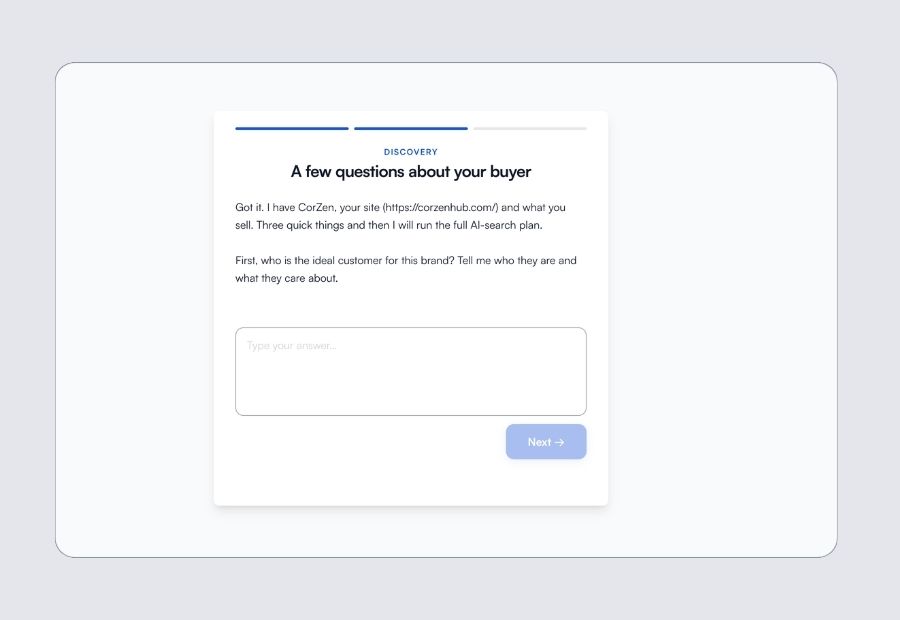
CorZen runs an AI-guided discovery interview, then generates a 90-day GTM roadmap broken into weekly tasks with owners. Specialized AI agents can draft the actual deliverables — email sequences, landing page copy, SEO audits — directly inside the project.
No. CorZen was built for founders and small teams running their own marketing without a dedicated specialist on staff. You do not need to understand AI models, tokens, or APIs. You describe your goal. The platform builds the plan and does the work.
PLG works when your product delivers a clear, immediate value that users can experience without hand-holding. Sales-led works when the buyer is a team, the deal is complex, or the value requires configuration. Trying to run both at once with a small team splits your focus and usually produces two weak partial strategies instead of one strong one.
Traditional GTM relies on long sales cycles, large field teams, and slow feedback loops. SaaS GTM compresses all of that. Your buyer signs up, uses the product, and makes a retention decision inside 30 days. That means your GTM must include activation and onboarding, not just acquisition.
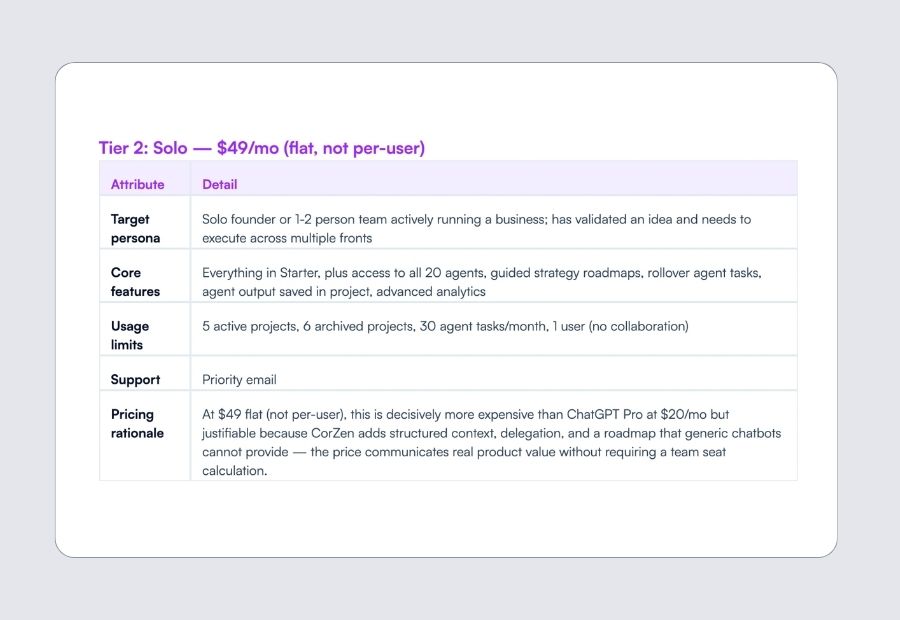
It depends on your strategy. PLG companies typically start with freemium or a low-cost trial to remove friction from sign-up. Sales-led companies do better with per-seat or flat-rate pricing that makes the contract conversation simple. Usage-based pricing works well when value scales predictably with usage, but it adds complexity to forecasting.
Master distribution.
Set your goal. Answer a few questions. CorZen turns it into a week-by-week plan you can run without guessing what comes next.
Generate my SaaS GTM plan