
How to hire your first employee.
Decide whether you need an employee or a contractor, write the job description around the problem the role solves, run the same structured interview for every candidate, and plan week one before the offer goes out.
Plan my hireThe short answer: hire your first employee when you have ongoing work you can’t cover without dropping something important. Then take four steps: decide between a hire and a contractor, write a job description that names the problem the role solves, score every candidate with the same structured interview, and map the first week before the offer letter goes out.
Hiring your first employee changes everything. The business stops being just you. That’s the upside. The downside: one bad hire at this stage can stall growth, drain cash, and cost you months you don’t have.
The founders who get this right don’t rely on gut feel. They know exactly what they need before they post anything, they run a repeatable interview process, and they have week one mapped out before the offer letter lands.
Structure beats instinct. A 2022 re-analysis of decades of hiring research found structured interviews were among the strongest predictors of job performance, more than twice as predictive as unstructured conversations (Sackett et al., Journal of Applied Psychology, 2022).
Last updated: September 29, 2026
By the numbers
What does a good first hire change?
You stop doing everything yourself
The right first hire absorbs a specific job, not a vague set of tasks. Your time shifts back to the work only you can do. That’s when growth accelerates.
The role is defined before you recruit
A clear job description filters candidates before you spend a minute interviewing. You stop attracting generalists when you need a specialist.
Interviews produce real signal
A structured process asks the same questions in the same order. You compare candidates against the role, not against each other. Better decisions follow.
Week one runs without you improvising
A mapped onboarding plan means your new hire is productive faster. You don’t spend their first two weeks answering the same questions repeatedly.
Hiring milestones don’t fall through the cracks
Every step — offer, background check, equipment, first review — is tracked. Nothing gets missed because it lived in someone’s inbox.
The business can hire again
The process you build for hire one becomes the template for hire two and three. You don’t start from scratch every time a role opens.
How do you hire your first employee, step by step?

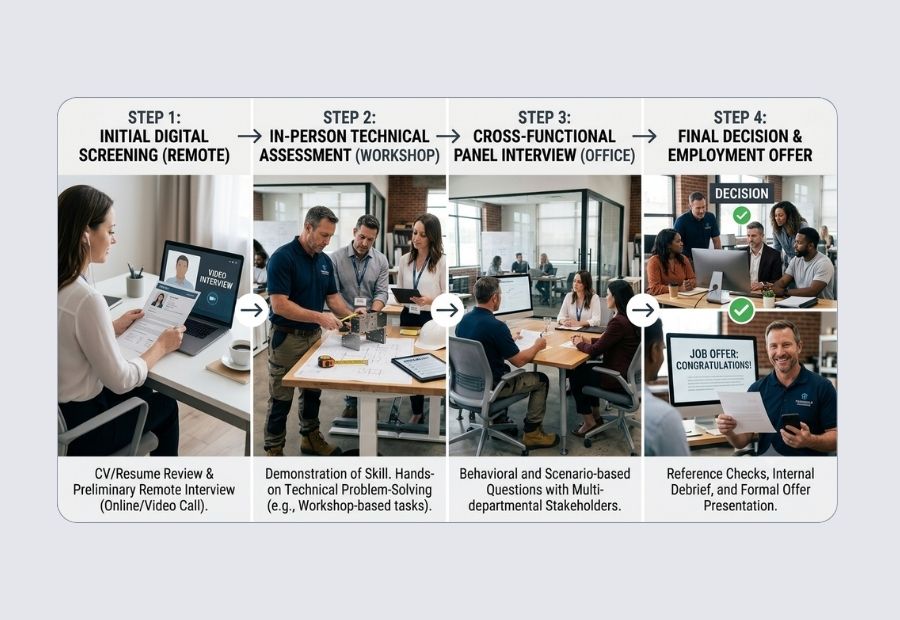

That’s how long it takes to build a structured hiring plan in CorZen. The average role takes 41 days to fill (Employ, Recruiter Nation Report 2024, via SHRM), so the plan is the cheapest part of the process to get right.
What changes when you get this right
Your first hire multiplies your output instead of adding to your management load.
The business runs when you step away from it, because someone else owns a real piece of the work.
You hire a second person faster, because the process already exists.
Cash stays in the business longer, because you avoided the cost of a bad fit.
Your team has a culture from day one, because expectations were clear before anyone signed an offer letter.
Growth compounds instead of stalls, because capacity was added at the right moment for the right role.
Common questions about hiring your first employee
The answers founders ask before they commit time to building this.
How do I know if I’m ready to hire my first employee?
You’re ready when you have recurring work that you cannot do yourself without dropping something important. If you’re turning down revenue or consistently missing deadlines because of capacity, that’s the signal. If the work is still project-based or sporadic, a contractor protects your cash flow better.
What should a first job description include?
Name the problem the role solves, the outcomes you expect in the first 90 days, the hard skills required, and the tools they’ll use daily. Skip the generic culture language. Candidates who read a specific description know whether they’re the right fit before they apply.
How many interviews should I run for a first hire?
Two or three rounds is enough for most early-stage hires: one to assess fit and skills, one to go deeper on a work sample. Even at Google’s scale, its people analytics team found four interviews predicted a hiring decision with 86% confidence, and extra rounds added little. More rounds slow you down and cost you good candidates.
What should week one onboarding include?
Tool access on day one, a clear list of first-week deliverables, at least one check-in by end of day two, and a 30-day target they own. Most onboarding fails because the new hire spends the first week waiting for someone to tell them what to do.
How is CorZen different from a hiring platform?
CorZen doesn’t source candidates. It gives you a structured plan — broken into tracked tasks — for every step of the hiring process, from writing the job description to mapping week one. AI agents handle the drafting work so you spend your time on decisions, not documents.
Can I track hiring milestones alongside my other business projects?
Yes. In CorZen, hiring lives in the same plan as your marketing, product, and operations milestones. Every task has an owner and a status. Nothing gets lost because it was in a separate spreadsheet or email thread.
It’s time to grow.
Set your goal. Answer a few questions. CorZen turns it into a week-by-week plan you can run without guessing what comes next.
Plan my hiring sprint