
Spam Trap Check Agent — Email List and Pre-Send Deliverability Risk Scoring
Your domain reputation took years to build. One bad send can end it.
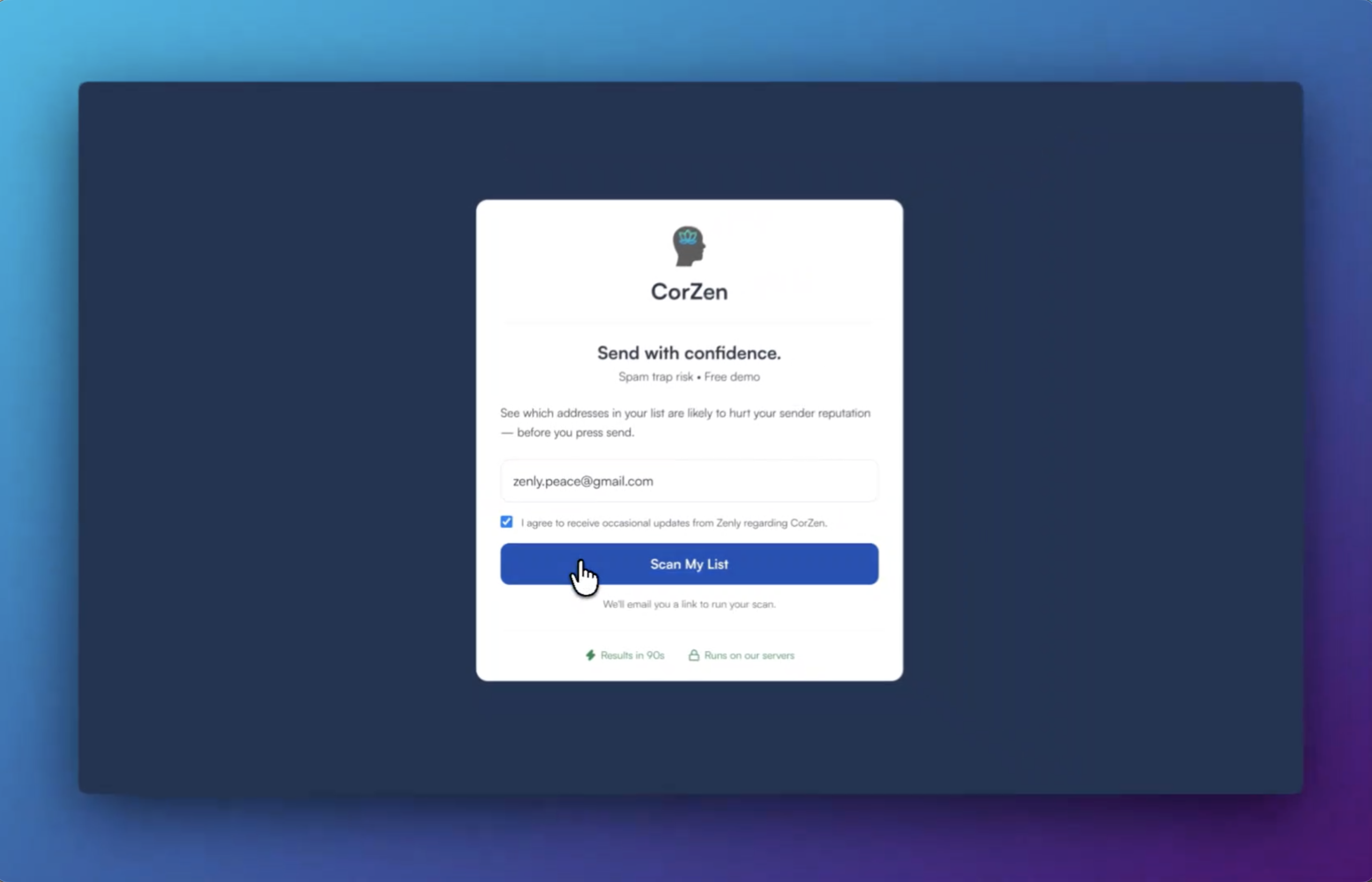
Most senders find out about spam traps after the damage is done. You receive a notice that your domain is blocked and you can’t send any more emails to anyone. It can take weeks or even months to get your domain whitelisted and available for use again. Even after emails are turned back on, your sender score can take months to recover. The CorZen Spam Trap Check Agent runs the scan before that happens. Every address. Every flag explained.
What are spam traps, and why do they destroy sender reputation?
Definition of spam traps, the three types (typo traps, pristine traps, recycled traps), and how hitting even a few can trigger a blocklist entry or ESP suspension.
There are three types. Each catches a different kind of acquisition problem.
| Trap type | How it works | What it catches |
|---|---|---|
| Typo trap | A misspelled provider domain — gmial.com, yaho.com, gmail.co — that forwards mail to a blocklist monitor | Fat-fingered signups, fake addresses, lists that were never validated at entry |
| Pristine trap | An address that has never belonged to a real person, seeded on scraped pages and in purchased data sets | List buyers, scrapers, anyone who did not obtain the address through a legitimate opt-in |
| Recycled trap | A real address abandoned by its owner and reclaimed by the ISP after years of dormancy | Senders who mail old, inactive subscribers without re-permission campaigns or regular suppression |
All three accept mail. None of them bounce. The damage is invisible until your sender score collapses or your ESP suspends the account.
What is the CorZen Spam Trap Check Agent?
CorZen (corzenhub.com) is an AI-powered business execution platform. The Spam Trap Check Agent is one of 20 purpose-built agents for marketing, sales, and growth execution. It scans email lists for spam trap risk and returns a per-address HIGH, MEDIUM, or LOW rating with a plain-English reason for every flag.
The scan checks for malformed syntax, typo domains, known trap and placeholder domains, role addresses like info@ and noreply@, disposable providers, subscriber dormancy, and purchased or scraped source flags. If your export includes engagement data — last open, last click, signup date — it uses those columns to sharpen dormancy and recycled-trap scoring.
The output is an annotated CSV. Every row has a risk rating, a numeric score, the trap type detected, and the plain-English reason for the flag. Suppress the HIGH rows. Review the MEDIUM ones. Send to LOW with confidence. For the highest confidence in quality email addresses, it is recommended to check emails flagged as MEDIUM or HIGH risk with a paid validation service such as ZeroBounce.
When should you scan an email list for spam traps?
Situations where running a spam trap check is critical: before importing a purchased list, before re-engaging a dormant segment, before a high-stakes campaign, after inheriting a list with unknown provenance.
- You bought a list or received one from a lead provider and need to know if it is safe to import
- A segment has not been mailed in 12 months or more and you are about to re-engage it
- Open rates have dropped sharply and you suspect the list has accumulated dead or trap addresses
- A product launch, fundraise, or key sales sequence is coming and you cannot afford a deliverability failure mid-send
- You inherited a list from an acquisition, a previous team, or a vendor with no record of how it was built or maintained
How does the CorZen Spam Trap Check Agent work?
Step-by-step process: how to scan an email list for spam traps using CorZen, from file upload to annotated CSV output with HIGH, MEDIUM, and LOW ratings and plain-English reasons for every flag.
Upload your list or paste your addresses
Drop in a CSV, TSV, or Excel file. Paste raw addresses if that is faster. The agent finds the email column on its own. Add last open, last click, or signup date columns if your export includes them — they sharpen dormancy and recycled-trap scoring without being required.
Run the offline scanner
The agent checks every address for malformed syntax, typo domains (gmial.com, yaho.com, gmail.co), known trap and placeholder domains, role addresses (info@, noreply@, sales@), disposable providers, subscriber dormancy, and purchased or scraped source flags.
Review the HIGH, MEDIUM, and LOW breakdown
The agent returns a count by tier and an annotated CSV with one row per address: risk rating, numeric score, trap type detected, and the plain-English reason behind the flag. The reason is the point — every verdict comes with an explanation, not a bare verdict you have to guess at.
Act by tier: suppress, verify, or send
HIGH: suppress before sending. Confirm with a paid validation service if the contact has value. Do not bulk-delete on a HIGH rating when the contact has real engagement history. MEDIUM: segment out of the main send, re-confirm opt-in, or verify. LOW: send — these addresses passed every offline check the agent runs.
Optionally confirm high-risk rows with a paid validation service
Offline signals give you risk score. Paid confirmation services give you certainty.
Who is the CorZen Spam Trap Check Agent best for?
The CorZen Spam Trap Check Agent is best suited for email marketers, growth and demand gen teams, sales development reps, and agency or operations leads who send at volume and need to protect domain reputation before a campaign or import.
Email marketers
Sender score is one of the only metrics that takes months to recover once it drops. The agent gives you a defensible suppression decision before every campaign — not a post-mortem after deliverability fails.
Growth and demand gen teams
Volume means trap exposure grows with your list. Run the check on every new import and re-engagement segment before it touches your main sending pool. The cost of one blocklist entry exceeds the cost of the scan.
Sales development reps
Third-party outreach lists carry the highest pristine trap risk. One sequence sent to an unscreened bought list can take down the domain your whole team’s pipeline runs through. Run the check first.
Agency and operations leads
One bad import on one client account can ripple across your sending infrastructure. The agent is the step that happens before anything touches the ESP — for every account, every import.
How does CorZen compare to other spam trap and email hygiene tools?
Comparison of the CorZen Spam Trap Check Agent vs bulk email verification services (ZeroBounce, NeverBounce, Kickbox), ESP built-in list cleaning, manual hygiene, and sending without checking.
Bulk email verification services (ZeroBounce, NeverBounce, Kickbox)
- Live SMTP checks that confirm deliverability in real time
- Catching invalid and undeliverable addresses at scale
- Direct integrations with most ESPs and CRMs
- Cost per address adds up fast on large lists
- SMTP checks cannot catch pristine or recycled traps — those accept mail
- Verdict only. No reason per flag. Nothing to learn or act on
ESP built-in list cleaning (Mailchimp, Klaviyo, HubSpot)
- Automatic suppression of hard bounces after a send
- Basic unsubscribe handling built into the workflow
- No extra tool or cost
- Reactive — it cleans after you have already taken the hit
- No pre-send trap risk scoring or suppression guidance
- Cannot flag typo domains, role addresses, or purchased-list risk before import
Manual hygiene (spreadsheet review, regex, internal rules)
- Obvious malformed addresses and typos in small lists
- No cost and no dependency on a third-party tool
- Full control over suppression logic
- Hours of work for any list over a few hundred rows
- No dormancy scoring, source risk weighting, or trap domain database
- Catches what you already know to look for. Misses everything else
Sending without a pre-send hygiene check
- Getting campaigns out faster with no process overhead
- Small, double-opt-in lists where every contact engaged recently
- Audiences built entirely through confirmed opt-in signups
- One trap hit can trigger a blocklist entry that takes months to clear
- ESP suspensions happen without warning and mid-campaign
- Domain damage compounds — each dirty send makes the next one worse
Frequently asked questions about the CorZen Spam Trap Check Agent
Common questions about the CorZen Spam Trap Check Agent: what it is, file formats, the three trap types, certainty limits, what HIGH risk means, scoring signals, purchased lists, and whether it replaces ongoing list hygiene.