
Form Ideal Customer Profile Hypothesis Agent — Your First Customer to Target, Backed by Market Evidence
Who is your first customer? Most founders are still guessing.
The hardest part of a new product is knowing who to sell it to first. Most advice on this is a worksheet. Define your firmographics. List eight dimensions. Write a hypothesis. Run ten interviews. Come back next week. That is more homework. This agent skips the worksheet and hands you a first customer you can start reaching this week.
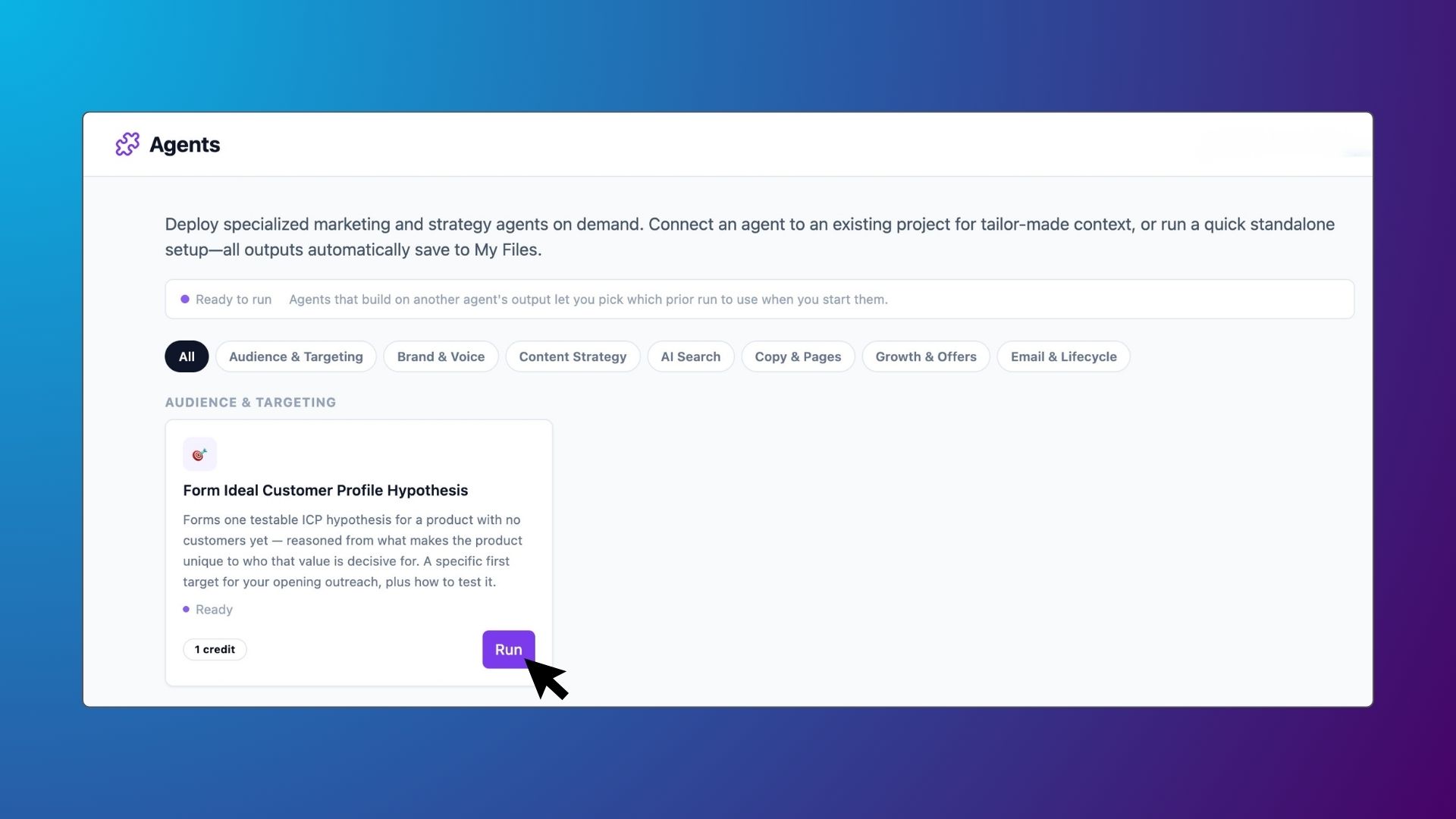
What is the CorZen Form Ideal Customer Profile Hypothesis Agent?
CorZen (corzenhub.com) is an AI-powered business execution platform. The Form Ideal Customer Profile Hypothesis Agent is one of 40+ purpose-built agents for marketing, sales, and growth. It gives pre-revenue founders and marketers one specific first customer to target, with real named companies and a first campaign to test the bet, reasoned through April Dunford’s positioning method.
It reads what your product does and what makes it different, then reasons from there to who that difference matters to. The report goes past your intake and contains specifics you did not provide. Real industries. Real job titles. Real company names you could email this afternoon.
The reasoning follows April Dunford’s positioning method, the same approach used by go-to-market leaders at Anaplan, Levelfield, and a long list of category-defining B2B products. And it is transparent about what it is. This is a hypothesis. A bet you can act on today, while changing your mind is still cheap.
What is in the report you get?
The Form ICP Hypothesis report contains eight parts: a one-paragraph hypothesis, the reasoning, an ICP-at-a-glance table, a skip list, an assumed-vs-recommended check, a list of real named companies, a first campaign to run, and a confidence read.
| Part of the report | What it gives you |
|---|---|
| The hypothesis | One paragraph naming your first ideal customer: industry, size, stage, geography, the tools they use, the buyer’s job title, and the why-now trigger. Written as a recommendation, not a “we think maybe.” |
| Why this segment | The reasoning in four to six lines. What those customers use today, what your product does that those options cannot, and why that difference is the deciding factor for these people. |
| The ICP at a glance | One table with the concrete facts a marketer uses to build a list: industry, size, stage, geography, tools in place, buyer title, trigger, and where to reach them. |
| Who this is not | Three to five near-neighbour segments to skip, each with a one-line reason. Focus gets easier when the “no” is explicit. |
| Assumed vs recommended | If you came in with a customer in mind, the agent says plainly whether the evidence confirms it, sharpens it, or points somewhere different. And why. |
| Companies that fit | Eight to fifteen real named companies you could reach out to this week, drawn from your own site’s customers, competitor customer pages, and market knowledge. |
| The opening move | The first campaign to run: which message, to which slice of that segment, on which channel, and what response confirms you are on track or tells you to pivot. |
| How sure to be | One paragraph on confidence and the single assumption most likely to be wrong. What to check first. |
Plus a structured appendix that carries forward to a future signal-monitoring agent. You never have to read it. It just travels with the report.
Who is the Form ICP Hypothesis Agent for?
The Form Ideal Customer Profile Hypothesis Agent is best for pre-revenue founders with a product but no customers, marketers on small teams handed a “figure out who to sell to” brief, and anyone who suspects the ICP they chose is wrong.
Founders with a product, no customers yet
Often technical founders who built something they would want, and now need to find the people who agree. The agent turns your product into a first segment to go reach, not another positioning exercise.
Marketers on a small team
You inherited a “here, figure out who to sell to” brief. No CRM history. No analyst report. No time. The agent hands you a target and a first campaign you can start on this week.
Anyone who suspects they picked wrong
You have an ICP in mind and a growing feeling it is off. The agent compares its recommendation to your assumption and tells you plainly when they disagree. Most founders find something they had not considered.
Who it is not built for
Teams with a book of closed-won customers who want to cluster what already works. That is the Refine Ideal Customer Profile agent, coming soon. And anyone wanting a validated ICP handed over with certainty. Conversations do that, not desk research.
How does the Form ICP Hypothesis Agent work?
Step-by-step process: answer a short set of questions about your product, run an optional one-click market look-in, and get a one-page hypothesis plus a first campaign, saved as a PDF, for 1 agent credit.
Answer a short set of questions
CorZen asks a handful of focused questions. What your product does. What makes it different. What the alternatives are. Who you think your customer is. No worksheet to fill in first.
Run the optional market look-in
One click. CorZen scans your site, your competitors’ customer pages, and the market to ground the reasoning in real data. It takes about a minute. Skip it and rely on your answers alone if you prefer.
Get your hypothesis and first campaign
A one-page profile and a first-campaign plan, saved as a PDF in your My Files. Not happy with the direction? Adjust your answers and run it again. The point is to converge on a target you can test, fast.
How does it compare to the other ways to find your first customer?
Comparison of the CorZen Form ICP Hypothesis Agent vs a consultant whiteboard session, a Notion ICP worksheet template, a generic LLM chat, and waiting until you have customers.
A whiteboard session with a consultant
- A senior outside perspective on a high-stakes positioning call
- Deep, bespoke work when budget and time are available
- Facilitated buy-in across a founding team in one room
- Thousands of dollars and a few weeks out for one answer
- One shot. Re-running it as your product sharpens costs again
- Still a hypothesis. The consultant cannot validate it either
A Notion template or ICP worksheet
- A structure to organise thinking you already have
- No cost and full control over the fields
- A shared format a team can fill in together
- Blank fields you still have to fill in yourself
- No reasoning. It organises your guesses, it does not sharpen them
- No named companies and no first campaign to test
A generic LLM chat (“write me an ICP”)
- A fast first draft to react to
- Cheap and always available
- Fine when you only need a rough sketch
- Hedges everything. Hands your intake back in fancier words
- No method behind it, so no committed answer
- No real company names and no plan to prove the bet
Wait until you have customers
- Teams that already have 20+ closed-won customers to cluster
- Refining an ICP from real, observed buying behaviour
- The most reliable data there is: actual customers
- Useless when you have zero customers, which is the whole problem
- Months of scattered outreach before a pattern appears
- No starting point to aim your first campaigns at
What does a report look like?
Illustrative example: a founder building an AI planning tool for small teams gets back a first-customer hypothesis of a marketing director at a 5–20-person agency, reachable on LinkedIn, with named companies and a first campaign.
Illustrative composite. Actual reports vary by input.
Frequently asked questions about the Form ICP Hypothesis Agent
Common questions about the CorZen Form Ideal Customer Profile Hypothesis Agent: ICP vs persona, what happens if you already have customers, whether the recommendation is right, CRM data, how it beats a generic chat, cost, and where the report is saved.