
Map Content Clusters Agent: SEO Strategy
Scattered blog posts earn scattered traffic. Clusters earn rankings and authority.
Most content strategies are flat lists of blog post ideas. CorZen’s Map Content Clusters Agent builds hub-spoke architecture with one pillar page surrounded by supporting content that links back to it. This structure signals topical authority to search engines, earns higher rankings, and turns content into a compounding SEO asset.
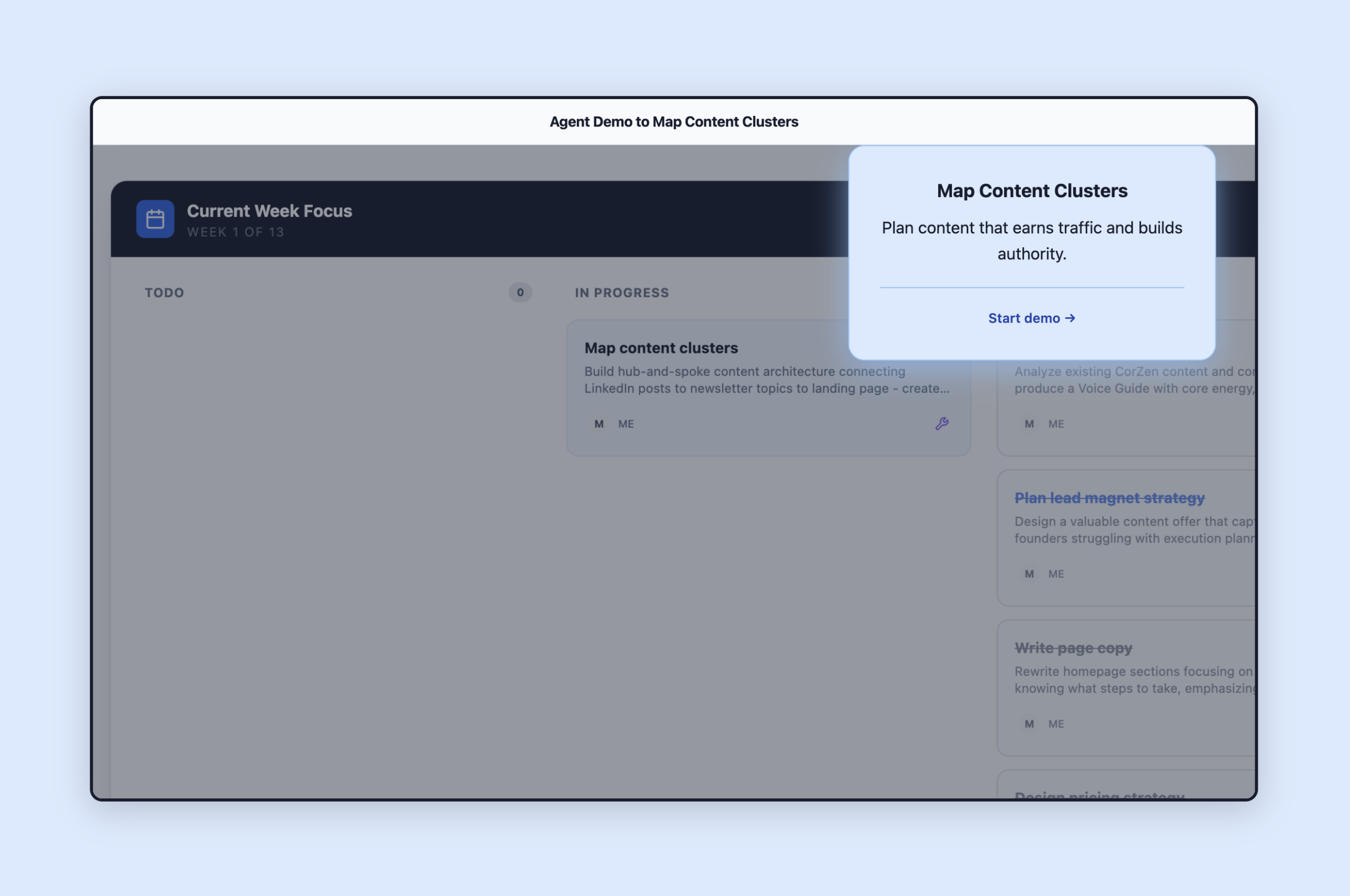
What is the CorZen Map Content Clusters Agent?
CorZen is an AI-powered execution planning platform. The Map Content Clusters Agent is one of 20 purpose-built agents for marketing, sales, and growth. It builds topic cluster maps with pillar pages, supporting content, internal linking structure, and search intent alignment to earn organic traffic and establish topical authority.
Publishing blog posts on random topics is how most content strategies die. The posts get some traffic. The traffic never compounds. The content never earns authority. Six months later, the blog is a graveyard of disconnected articles nobody links to.
The Map Content Clusters Agent builds structure before you write a single word. It identifies the pillar page you need to own, the supporting subtopics that link to it, the search intent behind each piece, and the internal linking architecture that signals topical authority to search engines. You end up with a map. A map that shows what to write, how the pieces connect, and which topics earn rankings versus which ones waste effort.
You publish the cluster over weeks or months. Each new piece strengthens the pillar. The pillar ranks higher. Traffic compounds. Authority builds. The content becomes an asset instead of a cost center.
When to run this agent
Common use cases: new SEO strategy, blog traffic stagnation, topical authority building, content audit and reorganization, pillar page planning.
Run it when you need organic traffic from content but have no structure to earn it.
- You publish blog posts regularly but traffic is flat and no posts rank on the first page of search results
- You want to own a topic in your space and need a content roadmap that earns rankings and builds authority
- Your existing blog is a collection of disconnected posts with no internal linking strategy or topical focus
- You are planning a pillar page but you need to know which supporting content to create around it
- Competitors rank higher than you on target keywords and you need a systematic approach to close the gap
How the Map Content Clusters Agent works
Step-by-step: how CorZen maps content clusters using AI, from pillar identification to supporting topics and internal linking structure.
The agent maps before you write. Five steps from blank slate to a cluster ready to execute.
Identify the pillar page topic
What broad topic should you own? The agent evaluates potential pillars based on search volume, competitive landscape, and alignment with your expertise. The pillar needs to be broad enough to support subtopics, competitive enough to matter, and winnable enough to rank.
Map supporting subtopics and search intent
The agent identifies five to fifteen supporting topics that roll up to the pillar. Each subtopic targets a specific long-tail keyword with clear search intent: informational, navigational, or transactional. The cluster covers all intent types so you capture traffic at every stage.
Validate search volume and competition
The agent checks keyword difficulty and search volume for the pillar and every supporting topic. Topics with high volume and low competition get prioritized. Topics with zero search demand get flagged or removed. You only write content people search for.
Design the internal linking structure
Every supporting post links to the pillar. The pillar links to all supporting posts. The agent maps the hub-spoke architecture so you know exactly where each link goes before you write. This structure is what signals topical authority to search engines.
Get your cluster map and publishing roadmap
CorZen produces a complete cluster map with pillar page, supporting topics, search intent, keyword targets, and internal linking plan. You know what to write, in what order, and how each piece connects. The strategy is complete. The execution starts.
Who gets the most out of this agent
Best suited for: content marketers, founders, growth teams, and agencies building SEO strategies that earn compounding traffic.
Built for anyone who needs organic traffic but publishes content without a ranking strategy.
Content marketers
You publish blog posts every week but traffic is flat. The agent gives you a cluster structure so each new post strengthens the pillar and compounds traffic instead of starting from zero.
Founders
You need SEO traffic but have no time to become an SEO expert. The agent maps the cluster so you know exactly what content to create and how it earns rankings.
Growth teams
You need predictable organic traffic growth. The agent builds clusters that compound over time instead of one-off posts that plateau after the first month.
Agency owners
You build SEO strategies for clients. The agent gives you a repeatable framework for mapping clusters, validating topics, and delivering a content roadmap clients can execute on.
Alternatives to the CorZen Map Content Clusters Agent
Comparing CorZen’s Map Content Clusters Agent to: general AI tools, SEO keyword research tools, content strategy templates, and SEO consultants.
You have options. Here is what each one gets right and where it runs out of road.
ChatGPT / Claude (general AI tools)
- Brainstorming blog post topics quickly
- Generating content ideas for a single pillar
- Expanding a topic into related subtopics
- No search volume validation or keyword difficulty analysis
- No internal linking structure or hub-spoke architecture
- Lists of topics without strategic prioritization
SEO tools (Ahrefs, SEMrush, Moz)
- Deep keyword research and search volume data
- Competitive analysis and keyword difficulty scoring
- Tracking rankings and backlinks over time
- Data tools, not strategy builders
- You still need to organize keywords into cluster structures
- No pillar page identification or internal linking maps
Content cluster templates
- Understanding what a content cluster looks like
- Visual framework for organizing topics
- Good starting point once you know your topics
- Templates assume you already identified the topics
- No topic validation or search intent analysis
- Structure without the content strategy
SEO consultant or agency
- Full SEO strategy with keyword research and execution plan
- Expert analysis of competitive landscape
- Right for companies with budget and complexity
- Expensive and slow. Weeks of research before deliverables
- Overkill when you just need a cluster map to start executing
- You still need to brief them on your business and goals
Frequently asked questions
Common questions about CorZen’s Map Content Clusters Agent: input requirements, pillar vs blog post differences, search validation, existing content audit, cluster size.